


How to find the best carpet for your home or commercial space.
This carpet buying guide will help you through every step of selecting and purchasing a carpet. Whether you’re looking for tips on choosing the right carpet material or finding the ideal underlay, there’s helpful information here to guide you.
How to choose the right carpet
There are numerous reasons why we appreciate carpets, not least because they work well in most rooms. They add warmth and comfort, tie together our interior design schemes, and provide a soft and cosy surface for us to walk and sit on.
Most popular in living rooms and bedrooms, carpets also reduce noise levels and are believed to improve indoor air quality by trapping dust and allergens. It’s no surprise that carpets are a beloved feature in many homes.
Although we all want good-quality carpets that match our décor, there’s more to buying a carpet than choosing the style and colour.
In this carpet buying guide, we look at key things to consider when choosing a carpet. For example, budget, carpet construction & composition, and pile weight.
Determining your budget
When buying new carpeting for your home, it is vital to consider your budget. Purchasing a new carpet can be a significant investment, so decide what price range you are comfortable with. Thankfully, there are carpets for all budgets.
While you will want the most from your budget, remember that carpeting is an investment in your home’s aesthetic appeal and the quality of your living space. So ensure your chosen product is affordable, cost-effective and suitable for your intended area.
Additionally, there are various types of carpet fibres and textures to choose from, each with different price points and levels of quality. Researching and comparing prices and features of different types of carpeting will allow you to make a smarter decision.
You must have accurate room measurements to ensure you are working with a realistic budget. Mistakes can occur by omitting recesses or presuming that opposite walls are equal, so take care if you are measuring the room yourself. Please see our carpet measuring guides if you need help calculating your space accurately.
Buying your carpet by room
Consider which room you are buying carpet for and the traffic it will have to cope with. For example, a bedroom carpet will usually have less people walking on it than a hallway or living room carpet. Therefore, you could go for a less hard-wearing bedroom carpet and splash out on a more expensive one, knowing it will retain its attractiveness and thick pile for longer.
Conversely, in areas of high traffic like hallways, you could opt for a heavier domestic-rated carpet to allow for the likelihood of extra usage. As flooring is often the most visible feature of a room, buying a carpet that can withstand its day-to-day usage is imperative.
Ultimately, choosing the carpet quality according to its likely use is best. Ask yourself, what is the room used for? How often will it be used? How many people will use the room? The significant factors to consider when evaluating carpet quality are carpet pile, fibre, backing, and density.
Carpet Construction
Carpet construction is a complex and intricate process that requires attention to detail and a thorough understanding of various materials, techniques, and tools used in its creation.
Each type of carpet construction has its unique characteristics and is suited for specific areas and uses. Understanding the different types of carpet construction is vital to making an informed decision when buying a carpet for your home.
Manufacturers generally construct carpets in two ways – twist piles and loop piles. There are other less common types, such as woven carpets (typically used in Axminster and Wilton carpets).
Twist Pile and Saxony Carpets:
Twist pile carpets share similar features with loop pile carpets, are popular in the UK and are made from twisted yarns cut to length. These create a springy, textured and durable finish. Unlike Saxony carpets, they don’t tend to flatten easily, making them suitable for areas that get more foot traffic.
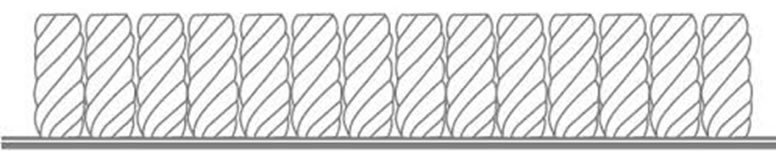
Saxony carpets have longer fibres than twist pile carpets, resulting in a deeper and plusher pile finish. When vacuumed or walked on, the pile tends to flatten and show indentations more easily. Therefore Saxony carpets are popular for areas such as bedrooms and are usually less ideal for high-traffic areas such as hallways.
Loop Pile and Berber Carpets:
Loop pile carpet is an excellent practical option for high-traffic areas. It contains looped yarns that can be arranged at the same or different levels to produce various patterns. Be wary of loop pile carpets if you have pets (particularly cats), as their claws can snag or pull on the loops.

Berber carpets also have a loop pile but with flecks of colour, and they tend to be more textured and irregular – the loops in Berber carpets are uncut and have a distinctive knot effect. Berber carpet pile is extremely hard-wearing, and the lower the loop, the more durable the carpets tend to be.
Understanding carpet construction is crucial when making decisions during your flooring project’s specification, purchasing, and fitting stages. This knowledge can greatly assist you in making informed choices.
Six Critical Things To Consider When Choosing Carpet

Carpet Composition
Carpet manufacturers make most carpets with synthetic fibres such as polyester, nylon and polypropylene. Others are made with natural fibres, most commonly wool. The type of yarn fibres used also affects how a carpet looks, feels, and performs.
Wool carpets are generally the most luxurious and are the perfect eco-friendly choice. They are made from natural, sustainable materials and have integral strength. They are more stain-resistant than many other carpet types and have a certain innate beauty. They are naturally hypoallergenic and generally resistant to unwanted things like dust mites, bacteria growth and mould.
Wool blend carpets most commonly come as 80% wool and 20% synthetic fibres. They are cost-effective and provide greater versatility and durability than most other carpets but are less durable than pure wool carpets.
Nylon/Polyamide is ideal for high-traffic areas. It is stain resistant, colour-fast and easy to clean. It is also subject to less flattening than polyester or polypropylene.
Polyester carpets are soft underfoot, hard-wearing, highly stain resistant, easy to clean, and possess a more lustrous sheen than carpets made from many other synthetic fibres.
Polypropylene is a manufactured material made from oil that is woven into different kinds of carpet styles. It is durable, hard-wearing and easy to clean. It is also colour-fast and resistant to moisture and stains.
Pile Weight/Density
The density rating of your carpet is an important factor that can affect its performance. In simple terms, carpet density numbers indicate the proximity of the fibres in your carpet that are tufted into the backing.
Pile weights/densities are typically measured using traditional imperial weights. These are given in ounces per square yard of carpet. Most weights nowadays are between 40oz and 70oz. The heavier the weight/density, the greater the luxury of the carpet pile.
Stair and lounge carpets are generally about 50oz, whilst 60oz to 70oz carpets are often more luxurious. The weight is not displayed on all carpets, and sometimes you can’t beat feeling the carpet to decide what best fits your needs.
Calculating carpet density can be complex, but you don’t need to worry about scrutinising numerous carpet samples and their density numbers. Reputable carpet stores will have all the information you need.
Carpet Warranties
Many carpets have warranties and guarantees that protect against stains, wear and tear, and overall appearance. You may have seen them – quality assurance warranties, stain and fade warranties – you name it, there is a warranty related to it.
Naturally, it is reassuring to have such assurances included, but very few carpets fade, wear or fall apart easily if you follow the manufacturer’s installation and carpet-care guidelines.
Generally, carpets with higher quality come with greater warranty coverage. However, prevent fantastic-sounding warranties from massively swaying your buying decision because many offer little true protection.
Most complaints regarding carpets stem from something other than manufacturing defects. For example, many are related to incorrect installation. You can usually take these complaints up with the retailer. Therefore, it’s important to ask about your options for recourse if you are unsatisfied with the carpet installation before purchasing.
Carpet Underlay
A carpet buying guide would only be complete with the mention of underlay. Worn or old underlay can reduce a carpet’s life because it doesn’t provide the proper support. We highly recommend getting underlay when fitting your new carpet. It significantly improves the durability and life of your carpet, and there are other benefits too:
Four Benefits of Carpet Underlay
Better look and feel: Underlay cushions your carpet, and it will help prevent the pile from flattening. Hence your carpet looks like new for longer.
Improved insulation: In many cases, good quality underlay reduces noise and keeps in heat. This can help reduce energy bills and save money.
Added protection: Not only does it act as an excellent shock absorber, but it helps carpets to sit correctly and be more durable.
Easier cleaning: Underlay protects a carpet’s pile, making it more hygienic and easier to clean. It will also aid your vacuum in working more effectively.
Our range of carpet underlay is available in five grades, depending on the required thickness and density.

Whether you choose a high tog rating to help keep your home warm and cosy or a high acoustic rating to reduce noise. The underlay will extend your carpet’s life and keep it looking good. We will happily advise you on the underlay that best suits your requirements.
Why do we like carpets?
Carpets offer a comfortable floor covering. Their versatility and range of colours make them suitable for almost any room. In addition, they come with several benefits. Carpets help reduce heat loss effectively, absorb sound more than most types of flooring and provide you with a soft and warm surface to walk, sit or play on.
Which? Survey of Carpet Buyers
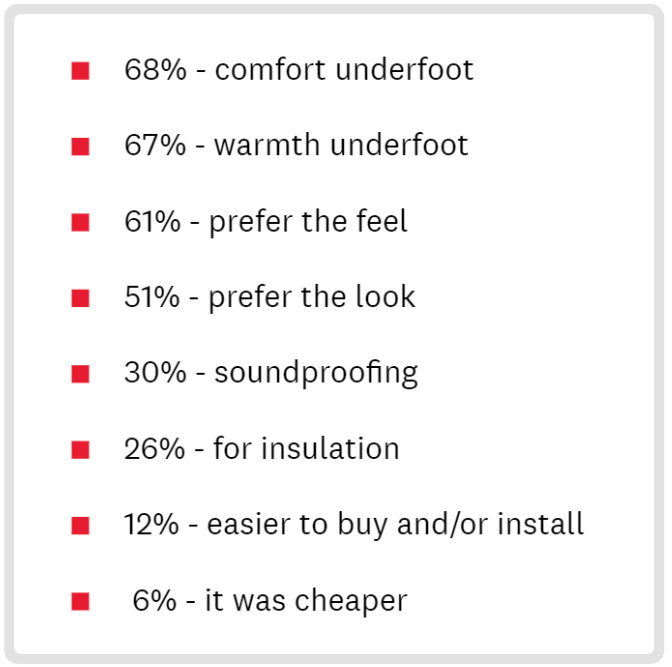
In November 2021, Which? – the UK’s consumer ‘champion’ surveyed 6,381 people who had bought a carpet in the past five years.
Most respondents stated that they selected their carpet based on factors such as comfort, warmth, and texture. Here’s a screenshot of the comprehensive list of the primary reasons why people said they chose carpet:
Customers and carpet owners we speak to at The Carpet Stop identify similar practical reasons why they often choose carpet rather than other types of flooring.
Carpet Buying Guide Summary
Carpets are a popular choice for their cosy feel and soft texture. They add warmth to your home’s atmosphere and enhance the decor by complementing your furniture and wall colours. When buying carpet for your home, selecting the right type is a crucial decision.
Different materials, colours, patterns, styles, and pile options exist when selecting a carpet. Depending on your lifestyle, budget, and maintenance preferences, you can opt for synthetic or natural fibres, low or high pile, a neutral or bold colour, and a modern or traditional pattern.
Additionally, you’ll need to consider the room’s traffic level and any special requirements such as anti-allergy, anti-stain or pet-friendly materials. With these factors in mind and thanks to the wide range of options available, you can find the perfect carpet that will elevate the look and feel of your living space.
If there is anything in this carpet buying guide that you need help with, don’t hesitate to contact us; a team member will be happy to help you.